
In today’s digital world 🌍, new identity-related terms appear online every day. One term that many people see on social media, forums, TikTok, Reddit, and conversations about gender identity is AFAB. If you have searched for afab meaning, you are not alone.
Many people feel confused when they first encounter this term. Some wonder if it relates to biology, gender identity, or social labels. Others simply want to understand how people use it in daily conversations.
The good news is that the meaning is actually easy to understand once explained clearly. In this detailed guide, you will learn:
- What AFAB means
- The full form of AFAB
- Where the term came from
- How people use it online and offline
- The difference between AFAB and AMAB
- Common misconceptions
- Examples in real conversations
- Why the term matters today
This article is written in a simple, beginner-friendly style while still providing expert-level information that follows modern understanding of identity and inclusive language. ✨
What Does AFAB Mean?
AFAB stands for Assigned Female At Birth.
This phrase refers to a person who was labeled female when they were born based on physical characteristics such as anatomy or chromosomes.
Doctors usually assign a baby’s sex shortly after birth. If the doctor identifies the baby as female, that person is considered AFAB.
However, a person’s later gender identity may or may not match that original assignment.
For example:
- An AFAB person may identify as a woman
- An AFAB person may identify as nonbinary
- An AFAB person may identify as transgender
- An AFAB person may identify differently over time
That is why the term is important. It separates birth assignment from gender identity.
AFAB Full Form
| Abbreviation | Full Form | Meaning |
|---|---|---|
| AFAB | Assigned Female At Birth | A person labeled female at birth |
The term is commonly used in discussions about:
- Gender identity
- LGBTQ+ topics 🌈
- Medical conversations
- Social experiences
- Online communities
Why Do People Use the Term AFAB?
People use AFAB because it provides a more accurate and respectful way to discuss identity and life experiences.
Instead of assuming someone’s gender identity, the term only describes the assignment given at birth.
For instance, calling someone “female” may not correctly describe how they identify today. AFAB avoids making assumptions.
Example
A person may say:
“I’m AFAB and nonbinary.”
This means:
- They were assigned female at birth
- They do not currently identify strictly as female
This language helps create respectful and inclusive communication. 💬
The Origin of AFAB
The phrase became more common during the growth of online LGBTQ+ communities and discussions around gender identity.
Before terms like AFAB and AMAB became widely used, conversations often relied only on the words “male” and “female.” However, many people felt these labels did not fully represent their experiences.
As awareness around gender diversity increased, communities started using more precise language.
The goal was simple:
- Reduce assumptions
- Respect identity
- Improve communication
- Create inclusive discussions
Today, AFAB is widely recognized across social media, education, healthcare, and identity-related conversations.
AFAB vs AMAB
One of the most common questions people ask is the difference between AFAB and AMAB.
| Term | Full Form | Meaning |
|---|---|---|
| AFAB | Assigned Female At Birth | Labeled female at birth |
| AMAB | Assigned Male At Birth | Labeled male at birth |
These terms describe birth assignment only. They do not automatically describe:
- Current gender identity
- Personality
- Appearance
- Pronouns
- Sexual orientation
AFAB and Gender Identity
To fully understand the afab meaning, it helps to know the difference between biological assignment and gender identity.
Birth Assignment
This happens when a doctor labels a newborn as male or female.
Gender Identity
This refers to how a person internally understands and experiences their own gender.
For some people:
- Their gender identity matches their birth assignment
- Their gender identity differs from their birth assignment
That is why AFAB exists as a descriptive term rather than an identity label.
Examples of AFAB in Conversations
Here are some realistic examples showing how people use the term online and offline.
Example 1
“I’m AFAB, but I identify as nonbinary.”
Example 2
“Many AFAB people share similar healthcare experiences.”
Example 3
“This support group is open to AFAB individuals.”
Example 4
“As an AFAB person, I experienced social pressure growing up.”
These examples show that the term often relates to personal experiences, healthcare, identity, or community discussions.
Common Misunderstandings About AFAB
Because the term is becoming more popular online, many misconceptions still exist.
Misconception 1: AFAB Means Someone Is a Woman
Not always.
An AFAB person may identify as:
- A woman
- A man
- Nonbinary
- Genderfluid
- Another identity
Misconception 2: AFAB Is an Insult
No. AFAB is a neutral descriptive term.
It is not offensive when used respectfully and correctly.
Misconception 3: AFAB Only Appears Online
While social media helped popularize the term, AFAB also appears in:
- Healthcare settings
- Educational discussions
- Research papers
- Support groups
- Identity conversations
AFAB in Social Media and Internet Culture
Social media platforms have played a major role in spreading identity-related language. 📱
You may notice AFAB used on:
- TikTok
- Discord
- X formerly Twitter
- YouTube comments
Creators often use the term while discussing:
- Life experiences
- Gender identity journeys
- Healthcare topics
- Fashion and presentation
- Social expectations
This increased visibility has made more people curious about the meaning of AFAB.
Why AFAB Matters in Healthcare
Healthcare professionals sometimes use AFAB because certain medical experiences can relate to birth assignment.
For example:
- Hormonal health
- Reproductive care
- Specific screenings
- Medical history
Using AFAB allows professionals to discuss medical needs accurately while still respecting gender identity.
This approach helps create safer and more inclusive healthcare environments. 🏥
Difference Between AFAB and Female
Many people think these words mean exactly the same thing, but they are not identical.
| Term | Main Focus |
|---|---|
| AFAB | Birth assignment |
| Female | Sex or identity depending on context |
AFAB specifically refers to what was assigned at birth. It does not automatically define current identity.
Related Terms You Should Know
When learning about AFAB, you may also encounter other related terms.
AMAB
Assigned Male At Birth.
Nonbinary
A person who does not identify strictly as male or female.
Transgender
Someone whose gender identity differs from the sex assigned at birth.
Cisgender
A person whose gender identity matches the sex assigned at birth.
Gender Identity
A person’s internal understanding of their gender.
How to Use AFAB Respectfully
Language matters. ❤️
Using identity-related terms respectfully helps create better conversations and understanding.
Helpful Tips
- Use the term only when relevant
- Avoid making assumptions
- Respect personal identity labels
- Listen to how individuals describe themselves
- Stay open-minded and informed
It is also important not to overuse the term unnecessarily.
For example, if someone introduces themselves as a woman, nonbinary person, or another identity, it is best to follow their preference.
AFAB in Real-Life Experiences
People who are AFAB may share certain social experiences growing up.
These experiences can include:
- Social expectations
- Dress standards
- Behavior expectations
- Family pressure
- School experiences
However, every individual experience is different.
Not all AFAB people feel the same way about identity, gender roles, or social expectations.
Why Younger Generations Use AFAB More Often
Gen Z and younger millennials tend to use identity-related language more openly online.
This trend exists because:
- Information is easier to access
- Online communities are larger
- Mental health awareness has grown
- Identity discussions are more visible
- Inclusive language is more accepted
As a result, terms like AFAB are now part of many online conversations.
Can AFAB Be Used Incorrectly?
Yes, sometimes people misuse the term by treating it as a replacement for identity.
For example:
- Not every AFAB person identifies as female
- Not every AFAB experience is identical
- Identity is personal and individual
That is why respectful and careful communication is important.
AFAB in Education and Awareness
Schools, universities, and awareness programs increasingly discuss inclusive language and identity concepts.
Educational conversations about AFAB can help:
- Reduce confusion
- Encourage empathy
- Promote respectful communication
- Create safer communities
Understanding terminology can improve everyday interactions both online and offline.
Quick Summary Table
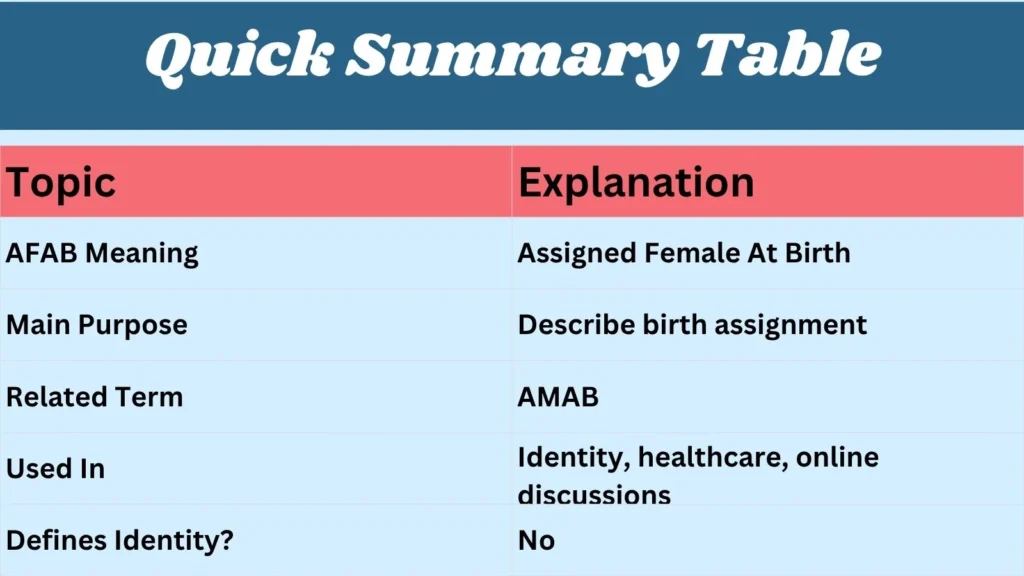
| Topic | Explanation |
|---|---|
| AFAB Meaning | Assigned Female At Birth |
| Main Purpose | Describe birth assignment |
| Related Term | AMAB |
| Used In | Identity, healthcare, online discussions |
| Defines Identity? | No |
FAQs:
What does AFAB stand for?
AFAB stands for Assigned Female At Birth.
Is AFAB the same as female?
Not exactly. AFAB describes birth assignment, while female may refer to biological sex or gender identity depending on context.
Can an AFAB person be nonbinary?
Yes. An AFAB person may identify as nonbinary, transgender, female, or another identity.
Why do people use AFAB instead of female?
The term avoids assumptions about identity and focuses only on birth assignment.
Is AFAB offensive?
No. AFAB is generally considered a respectful and neutral term when used correctly.
Conclusion:
Understanding the afab meaning is important in today’s evolving conversations about identity, communication, and inclusion.
The term simply means Assigned Female At Birth, but its purpose goes beyond a simple label.
AFAB helps people describe birth assignment without making assumptions about identity, expression, or personal experiences.
As discussions around gender and identity continue to grow online and offline, knowing respectful and accurate language becomes increasingly valuable. 🌟
Whether you discovered the term through social media, healthcare discussions, or personal curiosity, learning about AFAB can help you better understand modern communication and diverse experiences.

I am Yasir and i am a passionate writer and language enthusiast behind Sloganpoint, a platform dedicated to exploring meanings, word origins, and simple explanations. He aims to make learning vocabulary easy, engaging, and accessible for everyone.