
Have you ever seen the term ADL in a message, medical document, school discussion, or online conversation and wondered what it actually means? 🤔 You are not alone. The phrase ADL meaning has become increasingly popular because this abbreviation appears in several industries and conversations.
In some situations, ADL relates to healthcare and daily living skills. In other cases, people use it casually in online chats, educational settings, or professional communication. Because of these multiple meanings, many readers become confused when they first encounter the term.
This detailed guide explains everything you need to know about ADL meaning, including its definitions, origins, examples, modern uses, slang interpretations, and importance in healthcare and daily communication. 📚
Whether you are a student, caregiver, healthcare worker, parent, or simply curious, this article will help you understand ADL in the simplest way possible.
What Does ADL Mean? 📖
The abbreviation ADL most commonly stands for:
Activities of Daily Living
This term is widely used in healthcare, nursing, elderly care, rehabilitation, and disability support. It describes the everyday tasks people perform regularly to live independently.
These activities include:
- Eating 🍽️
- Bathing 🚿
- Dressing 👕
- Walking 🚶
- Using the bathroom 🚻
- Personal hygiene 🪥
Healthcare professionals often evaluate ADLs to determine whether a person needs assistance due to aging, illness, injury, or disability.
The Origin of ADL Meaning 🕰️
The concept of Activities of Daily Living became popular in healthcare during the mid-20th century. Doctors and therapists needed a practical way to measure how independently a patient could function after illness or injury.
Over time, ADL assessments became an important part of:
- Rehabilitation programs
- Nursing homes
- Disability evaluations
- Occupational therapy
- Elderly care planning
Today, ADLs are considered one of the most important indicators of a person’s independence and quality of life.
ADL Meaning in Different Contexts 🌍
One reason the keyword ADL meaning is searched frequently is because the abbreviation changes depending on the situation.
| Context | ADL Meaning |
|---|---|
| Healthcare | Activities of Daily Living |
| Education | Adult Learning |
| Technology | Application Description Language |
| Gaming | Attack Damage Life |
| Online Chat | Can vary depending on slang use |
However, the healthcare definition remains the most recognized and authoritative meaning worldwide.
Why ADL Is Important in Healthcare ❤️
Healthcare providers use ADLs to understand how much support someone needs in daily life.
For example:
- An elderly person recovering from surgery may struggle with bathing or dressing.
- A stroke patient may need help eating or walking.
- A person with dementia may forget personal hygiene routines.
Evaluating ADLs helps professionals create personalized care plans.
Without understanding ADLs, it becomes difficult to measure real-world independence.
Main Types of ADLs 🧩
1. Basic Activities of Daily Living
These are essential self-care tasks required for survival and independence.
- Eating
- Bathing
- Toileting
- Dressing
- Mobility
- Grooming
2. Instrumental Activities of Daily Living
These are more advanced skills needed for independent living.
- Cooking 🍳
- Managing finances 💰
- Shopping 🛒
- Using transportation 🚗
- Taking medications 💊
- Cleaning the house 🧹
Experts often call these IADLs.
Examples of ADL in Real Life 💡
Understanding ADL becomes easier with practical examples.
Example 1
A senior citizen can eat independently but needs help bathing. This means they have partial ADL dependence.
Example 2
A patient recovering from a broken leg may temporarily require assistance with walking and dressing.
Example 3
A child with developmental challenges may receive therapy focused on improving ADL skills.
ADL Meaning in Text and Online Chat 📱
In online communication, abbreviations often develop alternative meanings. However, ADL meaning in text usually depends on context.
Some people may use ADL casually in:
- Medical discussions
- Student conversations
- Social media posts
- Gaming communities
For example:
“My grandmother needs help with ADLs after surgery.”
In this sentence, ADL clearly refers to daily living activities.
Unlike slang abbreviations such as LOL or BRB, ADL is generally more professional and context-based.
ADL Meaning in Medical Terms 🏥
In medicine, ADL assessments are extremely important. Doctors and therapists use standardized tools to evaluate patient independence.
These assessments help determine:
- Rehabilitation progress
- Disability support eligibility
- Need for home care
- Long-term care placement
- Physical therapy effectiveness
Medical professionals often score ADL performance using rating systems.
| ADL Task | Independent | Needs Assistance |
|---|---|---|
| Eating | Yes | No |
| Bathing | No | Yes |
| Dressing | Partial | Partial |
These evaluations guide treatment decisions and care planning.
Who Uses the Term ADL? 👥
Many professionals and organizations use the term ADL regularly.
Healthcare Workers
- Nurses
- Doctors
- Occupational therapists
- Physical therapists
Caregivers
Family members and home aides often discuss ADLs when helping loved ones.
Insurance Companies
Some insurance plans use ADL limitations to determine benefits eligibility.
Educational Professionals
Special education programs may teach ADL skills to students with disabilities.
How ADL Assessments Work 📋
ADL evaluations are usually performed through observation, interviews, and physical assessments.
Healthcare providers may ask questions such as:
- Can you dress yourself?
- Do you need help bathing?
- Can you prepare meals independently?
- Are you able to walk safely?
The goal is to measure functional ability honestly and accurately.
ADL assessments are not designed to judge people. They help identify support needs.
ADL vs IADL: What’s the Difference? ⚖️
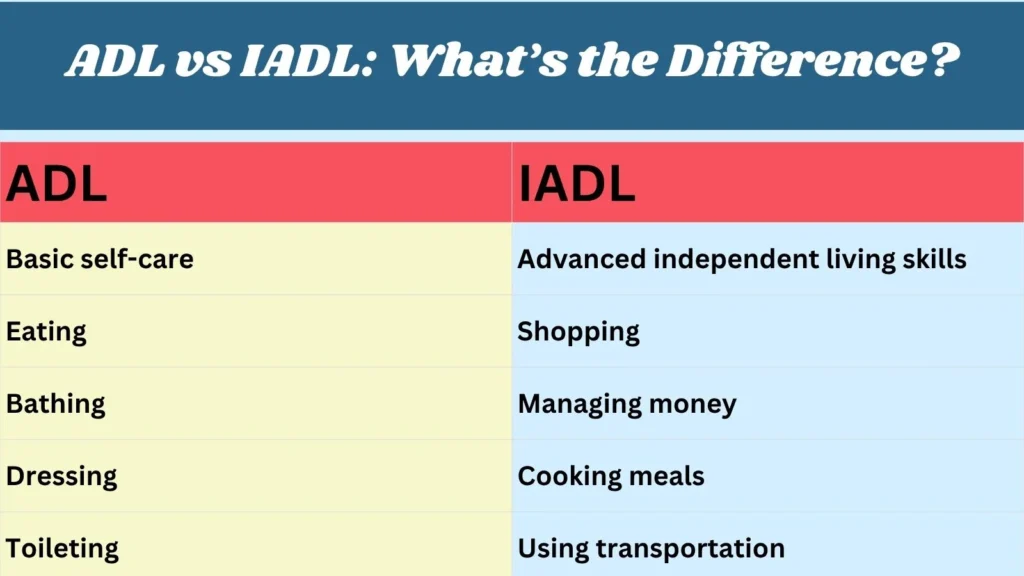
People often confuse ADLs and IADLs, but they are different.
| ADL | IADL |
|---|---|
| Basic self-care | Advanced independent living skills |
| Eating | Shopping |
| Bathing | Managing money |
| Dressing | Cooking meals |
| Toileting | Using transportation |
Both categories are essential for evaluating independence.
FAQs:
1. What does ADL mean in healthcare?
In healthcare, ADL means Activities of Daily Living, referring to basic self-care tasks.
2. Is ADL only used in medicine?
No. ADL may also appear in education, rehabilitation, caregiving, and online discussions.
3. What are the six basic ADLs?
The six common ADLs are eating, bathing, dressing, toileting, mobility, and grooming.
4. Why do doctors assess ADLs?
Doctors evaluate ADLs to understand a patient’s independence and support needs.
5. What is the difference between ADL and IADL?
ADLs involve basic self-care, while IADLs involve advanced independent living skills.
Conclusion:
Understanding ADL meaning is important because the term plays a major role in healthcare, caregiving, education, and rehabilitation.
Most commonly, ADL stands for Activities of Daily Living, which includes the essential tasks people perform every day to live independently.
From eating and bathing to mobility and personal hygiene, ADLs help professionals evaluate quality of life and support needs. The term may also appear in other contexts, but its healthcare meaning remains the most widely recognized.
Whether you are researching for education, caregiving, medical knowledge, or general curiosity, knowing the meaning of ADL can help you better understand independence, wellness, and human care. ❤️

I am Yasir and i am a passionate writer and language enthusiast behind Sloganpoint, a platform dedicated to exploring meanings, word origins, and simple explanations. He aims to make learning vocabulary easy, engaging, and accessible for everyone.