
Understanding the a-hole meaning is important in today’s digital communication world where slang terms are widely used in texting, social media, and casual conversations.
The term “a-hole” is a softened or censored version of a more offensive word, and its usage depends heavily on tone, relationship, and context.
In this detailed guide, we will break down everything about a-hole meaning, including its origin, real-life usage, emotional impact, and modern interpretations in 2026 communication trends 📱.
This article will help you clearly understand when the word is offensive, when it is humorous, and when it is simply used in a casual or joking way. Let’s explore this slang term in depth with expert-level clarity while keeping it simple and easy to understand 😊.
What is A-Hole Meaning in Simple Words?
The a-hole meaning refers to a slang term used to describe a person who behaves rudely, selfishly, or disrespectfully. It is a shortened, censored version of a stronger insult. People often use it in informal communication to express frustration without writing the full offensive word.
In simple terms:
- It describes someone acting mean or inconsiderate 😒
- It is often used in arguments or emotional situations
- It can sometimes be used jokingly among friends
However, tone matters a lot. The same word can sound insulting or playful depending on context.
Origin of the A-Hole Term 📚
The origin of the a-hole meaning comes from the abbreviation of a stronger vulgar term used in English language history.
Over time, people started shortening offensive words in writing, especially in media, newspapers, and online platforms to avoid censorship.
This led to the creation of “a-hole” as a softened form. It became widely popular in:
- Movies and TV shows 🎬
- Internet forums 💻
- Text messaging culture 📱
Today, it is considered semi-offensive but commonly used in casual conversations.
A-Hole Meaning in Text and Social Media
In texting and social media, the a-hole meaning has become very common. People use it to quickly express frustration or disappointment.
Examples include:
- “He ignored my message again, what an a-hole 😤”
- “Don’t be an a-hole, help your friend”
On platforms like Instagram, TikTok, and X (Twitter), it is often used in comment sections to react emotionally to someone’s behavior.
Different Contexts of A-Hole Usage
The meaning of a-hole changes depending on where and how it is used. Let’s break it down:
1. Casual Conversation
Among friends, it can be used jokingly without serious offense 😄.
2. Anger or Argument
During conflict, it becomes insulting and emotionally charged 😡.
3. Humor or Sarcasm
Sometimes used playfully in memes or jokes 😂.
4. Online Comments
Used to criticize someone’s behavior publicly.
Emotional Impact of A-Hole Word
Words carry emotional weight, and the a-hole meaning can strongly affect relationships if misused.
It may cause:
- Hurt feelings 💔
- Arguments or misunderstandings
- Loss of trust in relationships
That’s why tone and timing are very important before using this slang.
A-Hole vs Full Offensive Word
Many people use “a-hole” as a safer alternative to the full offensive word. The a-hole meaning is essentially a softened version used for censorship or politeness.
“Language evolves, and slang often becomes a way to express strong emotions without fully crossing boundaries.”
Compared to the original term, “a-hole” is:
- Less offensive
- More socially acceptable in informal writing
- Common in memes and jokes
Real-Life Examples of A-Hole Usage
Here are some real-life style examples of a-hole meaning in action:
- “He didn’t even apologize after what he did, total a-hole behavior.”
- “Stop acting like an a-hole and listen.”
- “That driver cut me off like an a-hole 😤”
These examples show how flexible the word is depending on emotional tone.
A-Hole in Pop Culture 🎬
The a-hole meaning is widely used in movies, TV shows, and stand-up comedy. Writers use it to make dialogue more realistic and expressive.
It often appears in:
- Comedy films
- Action movies
- Internet memes
This usage helps make characters feel more human and relatable.
Psychology Behind Using A-Hole Word 🧠
People use the term “a-hole” to release frustration or express strong emotional reactions. The a-hole meaning is often tied to emotional stress or anger.
Psychological reasons include:
- Stress release mechanism
- Quick emotional expression
- Social bonding through humor
Alternatives to A-Hole Word
If you want to avoid sounding rude, you can use alternatives instead of the a-hole meaning expression.
- Rude person 😐
- Selfish behavior
- Inconsiderate person
- Not nice behavior
These options are more polite and suitable for formal communication.
Is A-Hole a Bad Word?
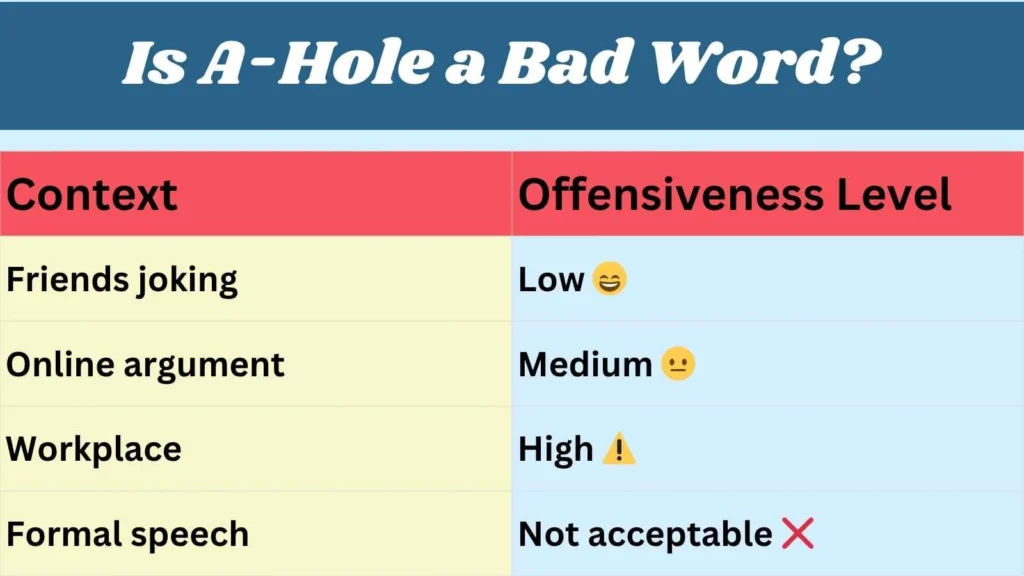
Yes and no. The a-hole meaning falls into a gray area. It is not the strongest insult, but it is still considered rude in formal settings.
Here’s a quick breakdown:
| Context | Offensiveness Level |
|---|---|
| Friends joking | Low 😄 |
| Online argument | Medium 😐 |
| Workplace | High ⚠️ |
| Formal speech | Not acceptable ❌ |
When Should You Avoid Using A-Hole?
Even though the a-hole meaning is common, there are situations where it should be avoided:
- Professional emails 📧
- Academic writing 🎓
- Talking to elders or authority figures
- Public speeches
Using respectful language always creates a better impression.
FAQs:
1. What is a-hole meaning in texting?
It means a rude or selfish person, often used informally in chats.
2. Is a-hole a bad word?
Yes, it is mildly offensive but commonly used in casual language.
3. Why do people use a-hole instead of the full word?
To avoid sounding too offensive or to comply with censorship rules.
4. Can I use a-hole with friends?
Yes, but only if your friends are comfortable with slang humor.
5. What is the polite alternative of a-hole?
You can use “rude person” or “inconsiderate behavior” instead.
Final Thoughts:
The a-hole meaning is more than just slang—it reflects emotion, tone, and context in communication.
While it is commonly used in informal conversations, it should be handled carefully to avoid misunderstandings.
In 2026 digital communication, understanding slang like this helps improve your social awareness and messaging skills.
Always remember: words carry power ⚡. Use them wisely depending on situation, audience, and intention.

I am Yasir and i am a passionate writer and language enthusiast behind Sloganpoint, a platform dedicated to exploring meanings, word origins, and simple explanations. He aims to make learning vocabulary easy, engaging, and accessible for everyone.