
Have you ever received a message with just “CM” and felt confused? 🤔 You are not alone. In today’s fast-paced digital world, people love using short forms and slang to communicate quickly. But sometimes, these abbreviations can leave us wondering what they really mean.
In this detailed guide, we will explore the Cm meaning in text, its different interpretations, real-life examples, and how to use it correctly in conversations. Whether you are chatting on WhatsApp, Instagram, Snapchat, or SMS, this guide will help you understand everything clearly. 🚀
Let’s decode “CM” step by step!
What Does Cm Mean In Text? 📱
The abbreviation Cm can have multiple meanings depending on the context. However, the most common meanings include:
- Call Me 📞
- Come 👉
- Centimeter 📏
- Check Message 💬
So, when someone sends “CM”, you need to look at the conversation context to understand its correct meaning.
Origin Of Cm In Texting 📜
The use of abbreviations like Cm started with SMS culture when character limits were strict. Over time, it became a common part of internet slang.
Top Meanings Of Cm In Texting 💡
1. Call Me 📞
This is the most popular meaning of Cm in texting. People use it when they want you to call them.
Example:
- “I need to talk urgently. CM.”
👉 Here, CM clearly means Call Me.
2. Come 👉
In casual chats, especially among friends, Cm can also mean “Come”.
Example:
- “Cm to my place tonight 😎”
3. Centimeter 📏
Sometimes, Cm is used in a non-slang context, especially in academic or measurement discussions.
Example:
- “The length is 25 cm.”
4. Check Message 💬
In some cases, CM may mean “Check Message”, especially when referring to another chat.
Example:
- “I sent details in DM, CM.”
How To Understand The Correct Meaning? 🧠
Understanding the Cm meaning in text depends on these factors:
- Conversation tone
- Platform used
- Relationship with sender
- Message context
“Context is everything in digital communication.”
Where Is Cm Commonly Used? 🌐
You will often see Cm used on:
- WhatsApp chats
- Instagram DMs
- Snapchat messages
- SMS texting
- Online gaming chats 🎮
Is Cm Formal Or Informal? 📝
Cm is mostly informal. It is commonly used in casual conversations and not recommended in professional communication.
Avoid using CM in:
- Business emails
- Formal documents
- Professional chats
Why Do People Use Cm? ⚡
People prefer short forms like Cm because:
- They save time ⏱
- They are easy to type 📲
- They feel modern and trendy 😎
Other Similar Texting Abbreviations 🔤
Here are some related slang terms:
- BRB – Be Right Back
- TTYL – Talk To You Later
- OMG – Oh My God
- IDK – I Don’t Know
When Should You Avoid Using Cm? 🚫
You should avoid using Cm when:
- The message may cause confusion
- You are talking to someone unfamiliar with slang
- You are in a formal setting
Common Mistakes People Make ❌
- Assuming CM always means Call Me
- Using it in professional emails
- Misunderstanding context
Examples Of Cm In Conversations 💬
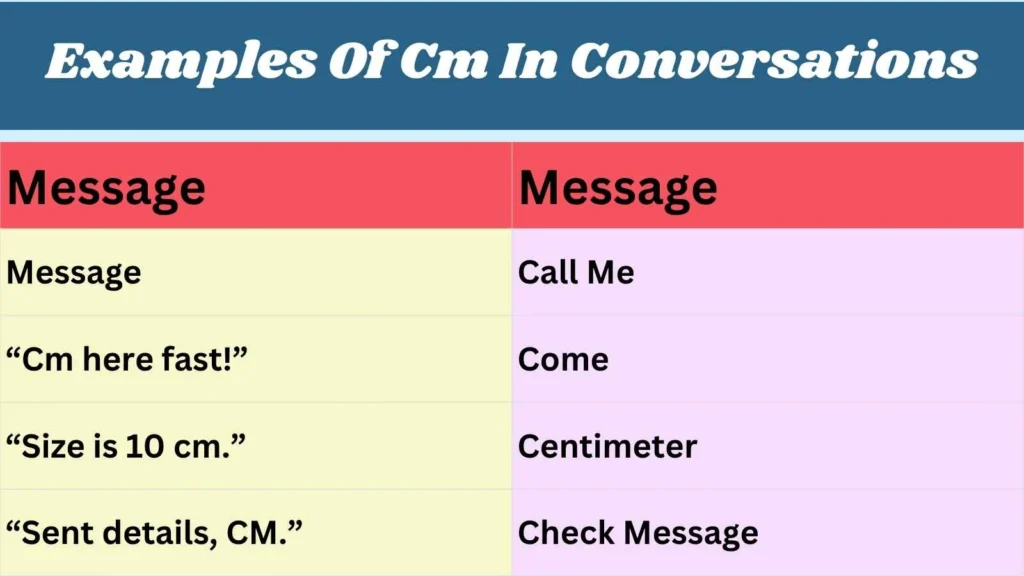
| Message | Meaning |
|---|---|
| “Hey, CM when free.” | Call Me |
| “Cm here fast!” | Come |
| “Size is 10 cm.” | Centimeter |
| “Sent details, CM.” | Check Message |
Pro Tips To Use Cm Correctly ✅
- Always check the context
- Use it only in casual chats
- Clarify if unsure
Is Cm Popular In 2026? 🔥
Yes! Cm is still widely used in 2026, especially among younger users who prefer quick and efficient communication.
FAQs:
1. What is the most common meaning of Cm in text?
The most common meaning is Call Me.
2. Can Cm mean something else?
Yes, it can mean Come, Centimeter, or Check Message depending on context.
3. Is Cm used in professional communication?
No, it is considered informal.
4. How do I know what Cm means?
Look at the conversation context.
5. Is Cm slang or abbreviation?
It is both a slang and abbreviation.
Conclusion:
The Cm meaning in text may look simple, but it carries different meanings depending on how it is used.
From Call Me to Come, understanding context is the key to interpreting it correctly.
By now, you should feel confident using and understanding Cm in everyday conversations. 👍

I am Yasir and i am a passionate writer and language enthusiast behind Sloganpoint, a platform dedicated to exploring meanings, word origins, and simple explanations. He aims to make learning vocabulary easy, engaging, and accessible for everyone.